Case Study - 2015 to 2020
HICKIES — Building a Brand from the Inside Out
Company
HICKIES, Inc.
Role
Digital Designer (Sole)
Scope
End-to-End Digital Product
Duration
5 Years
OVERVIEWA product with purpose, a brand without a system
HICKIES made a genuinely useful thing — a no-tie elastic lacing system that transformed any sneaker into a slip-on. What started as a Kickstarter idea from two founders in Brooklyn grew into an internationally distributed consumer brand carried in retailers across five continents.
But when I joined in 2015, the digital experience hadn't kept pace with the product's ambition. The website was fragmented. The brand had no coherent visual language across digital touchpoints. The user experience was inconsistent from homepage to checkout. And as the company began expanding its product line: Kids, Metallics, Swarovski, DooHICKIES Charms, the need for a scalable design foundation became urgent.
I was brought in as the sole digital designer. What followed was five years of building, shipping, and scaling a complete digital design system across two distinct product platforms, consumer retail and B2B wholesale, from the ground up.
THE CHALLENGEThree products. Two audiences. One designer.
The core challenge wasn't aesthetic, it was systemic. HICKIES needed a design language that could hold together an expanding product catalog, serve both a direct consumer and a wholesale distributor, scale across desktop and mobile, and remain coherent as the brand entered new markets and product categories.
I also had to solve a product communication problem unique to HICKIES. The lacing system replaced something every customer already thought they understood. How do you clearly communicate a better way of doing something people assume they've already mastered? Every design decision, from information hierarchy to interaction flow, had to earn the customer's curiosity before it could earn their purchase.
SCOPE OF WORK
Every digital touchpoint. Every user state.
Design System
UI Style Guide
Typography Scale
Color System
Component Library
Iconography
Button States & Variants
Form Components
B2C Platform
Homepage
Product Listing Pages
Product Detail Pages
Bundle Builder Flow
Custom Fit Quiz
Cart & Side Cart
Store Locator & Events
Order Lookup
Help Center
B2B Platform
HICKIES Network Portal
Wholesale Ordering
Distributor Profiles
Sales Training Flows
Sales Tools Library
Multi-Step Checkout
Mobile Navigation
BUSINESS IMPACT
Five years of work. Numbers that tell part of the story.
These outcomes belong to the full team. But every product launch, market expansion, and conversion improvement ran on a digital foundation built from scratch and maintained through five years of growth.
6x
E-commerce revenue growth achieved in 2016, building on 5x growth the prior year
70%
Of total company revenue generated through e-commerce by the time of exit
3.7%
Average conversion rate achieved alongside a 20% increase in average order value
APPROACH
Foundation first. Everything else follows.
Before designing a single screen, I identified the core problem, without a shared visual language, every new product launch, campaign, or market expansion would require starting from zero. I built the design system first so that everything that came after could be built faster, more consistently, and with less rework.
-
Mapped every existing digital touchpoint to identify inconsistencies in typography, color usage, button behavior, and navigation patterns. The 2015 site had no shared visual grammar, each page felt like a different product.
-
Built a comprehensive UI style guide from the ground up: a defined typographic scale using Sharp Sans, a structured color system with primary, secondary, and accent tokens, a full button component library with states and variants, form components, and a custom iconography set spanning fitness, travel, accessibility, and product use cases.
-
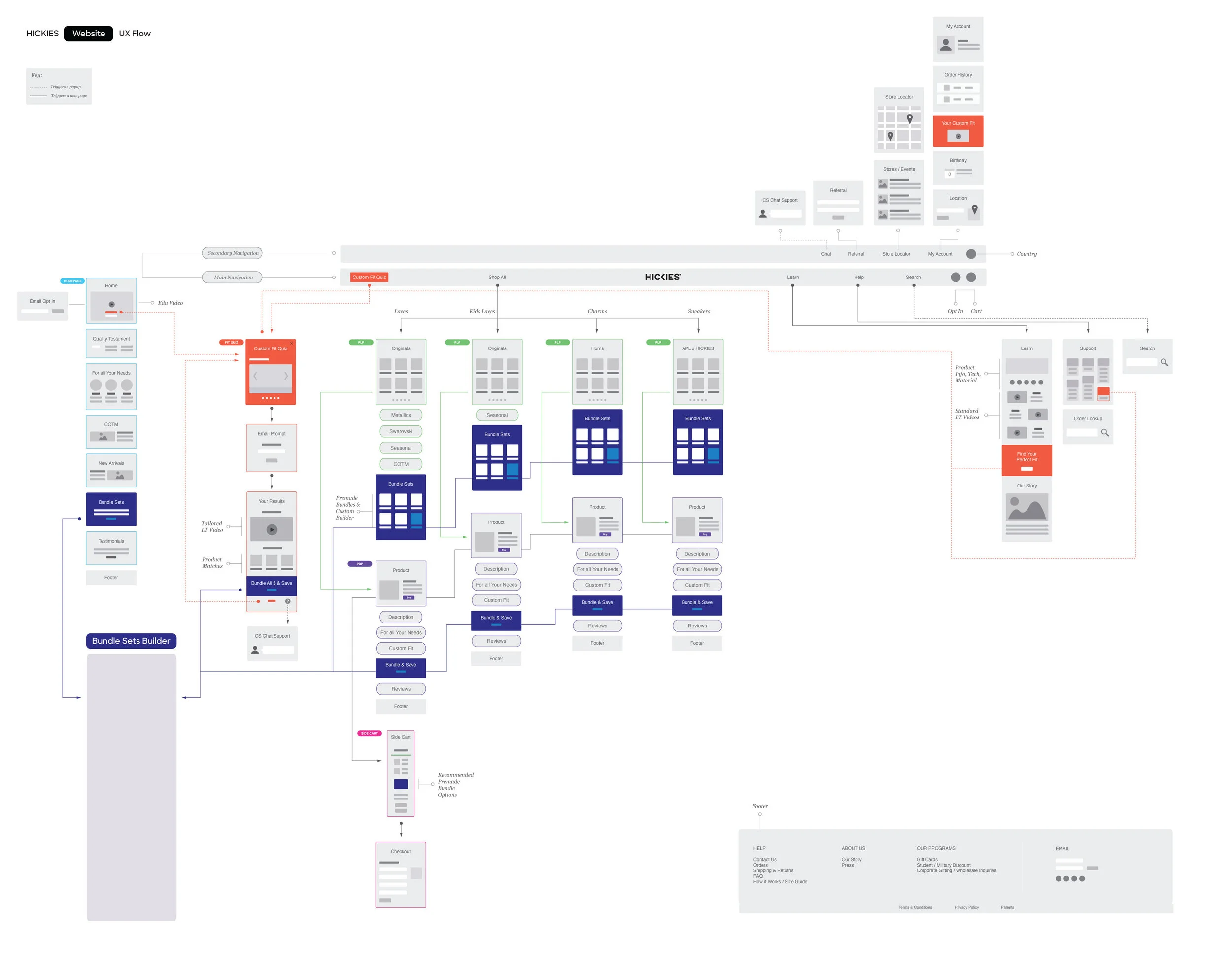
Rebuilt the full B2C experience across desktop and mobile: homepage, product listing and detail pages, bundle builder, Custom Fit Quiz, cart, order management, help center, and store locator. Every screen designed with consistent components, responsive behavior, and a clear conversion intent.
-
Designed a parallel product called HICKIES Network for wholesale distributors and retail partners. A completely distinct user type with different goals, different information needs, and a different purchasing flow. Built on the same design system but with its own information architecture, navigation, profile management, and checkout experience.
-
Worked directly alongside developers throughout implementation to ensure design intent translated accurately to the live product. Maintained the design system as a living reference throughout five years of product expansion and iteration.
Every choice had a reason.
Made the Custom Fit Quiz the primary navigation CTA, solving the customer's first real problem (which HICKIES is right for me?) before asking them to browse or buy.
Designed the bundle builder as a guided flow rather than a product grid, reducing decision fatigue for a product that came in multiple sizes, colors, and configurations.
Built the side cart with contextual upsell ("Goes Well With"),surfacing complementary products at the moment of highest purchase intent without interrupting the browsing experience.
Foregrounded the accessibility use case, "Transform shoes into hassle-free slip-ons for all", in the homepage hierarchy, recognizing that this was the product's most emotionally resonant story.
Designed the HICKIES Network as a distinct visual identity within the same system, giving wholesale buyers a professional, trustworthy environment that felt different from the consumer experience without requiring a separate design language.
KEY DECISIONS
WHAT I LEARNED
What this work taught me about design.
HICKIES was where I learned that a design system doesn't show up in a product demo, but every time a new product launches consistently, every time a developer implements a component correctly the first time, every time a customer completes a purchase without friction, the system is working.
It was also where I first understood the difference between designing for aesthetics and designing for people. The moment I found out that parents of children with disabilities were using HICKIES to help their kids put on shoes independently, that was the moment the work meant something. Not the visual execution. The outcome for a real person navigating a real limitation.
That's the kind of design I want to keep building toward.

UX Flowchart
UI Style Guide


Bundle Builder